

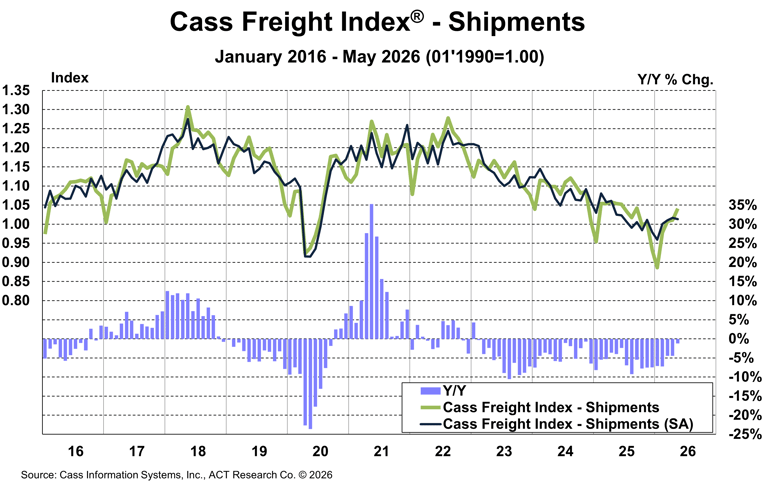
The shipments component of the Cass Freight Index rose 3.0% m/m in May, narrowing the y/y decline to 1.2%, the smallest in 18 months.
In seasonally adjusted (SA) terms, shipments fell 0.3% m/m after three straight gains totaling 6.0%, keeping the chances of a 2H recovery elevated.
Many spot indicators suggest improving freight demand, and certain sectors are executing well on growth, such as the domestic intermodal market.
At the May SA rate, this index would rise 1.8% y/y in 2H’26 and turn positive y/y in July.
The normal seasonal trend would put the shipments component of the Cass Freight Index down about 1% y/y in June.
See the Methodology for the Cass Freight Index
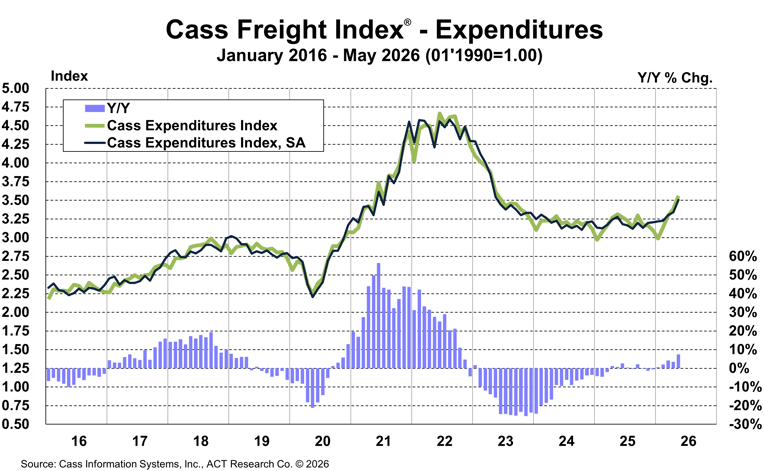
The expenditures component of the Cass Freight Index, which measures the total amount spent on freight, rose 7.5% y/y in May, accelerating from a 3.5% gain in April.
The acceleration was mainly due to slower shipment declines, while rates rose slightly.
In SA terms, the index rose 4.9% m/m in May, after a 1.2% m/m increase in March.
The expenditures component of the Cass Freight Index, after a record 38% surge in 2021 and another 23% increase in 2022, fell 19% in 2023 and 11% in 2024. In 2025, the index declined by 0.5%.
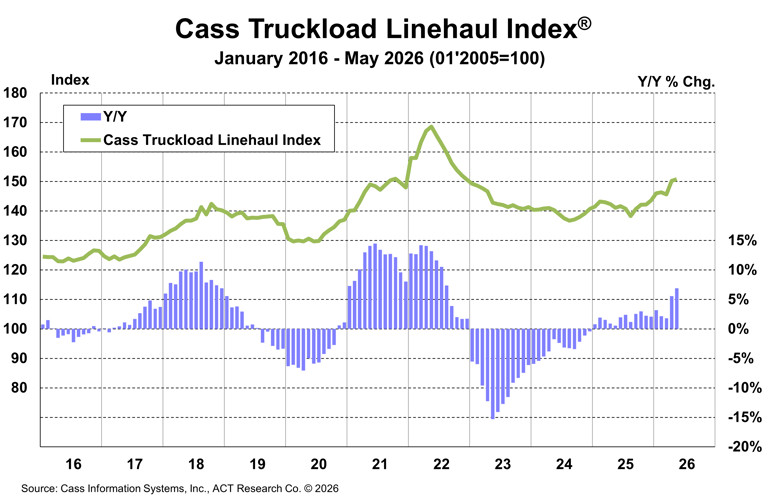
The Cass Truckload Linehaul Index rose to 150.8 in May, up 0.4% m/m and 6.9% y/y.
These linehaul rates exclude both fuel and accessorial charges, both of which are rising. In the refrigerated market in particular, accessorial charges are going up, perhaps for reefer unit fuel.
Volumes are beginning to recover, but it is mainly supply constraints supporting higher rates, in our view, both for equipment capacity and drivers.
TL rates are likely to continue their upward march in the coming months.
This index reflects the whole for-hire market, both spot and contract rates.
The Cass Truckload Linehaul Index fell 10% in 2023, another 3.4% in 2024, and turned up to a 1.8% increase in 2025.
See the Methodology for the Cass Truckload Linehaul Index

The volume recovery seems close, and while it will not likely be overwhelming from a demand perspective at current fuel prices, inventories are tight, tariffs are falling, and the U.S. dollar is soft, supporting the freight demand outlook. Tighter supply remains the main reason for accelerating rates.
As equipment investment declined and regulations fueled a driver shortage, the dislocation to an acutely tight TL market occurred fairly quickly this year. Most of this occurred before the May 14 Montgomery SCOTUS ruling, raising broker liability and further tightening capacity. In early June, DAT TL spot rates are tacking up about 40% y/y, net fuel.
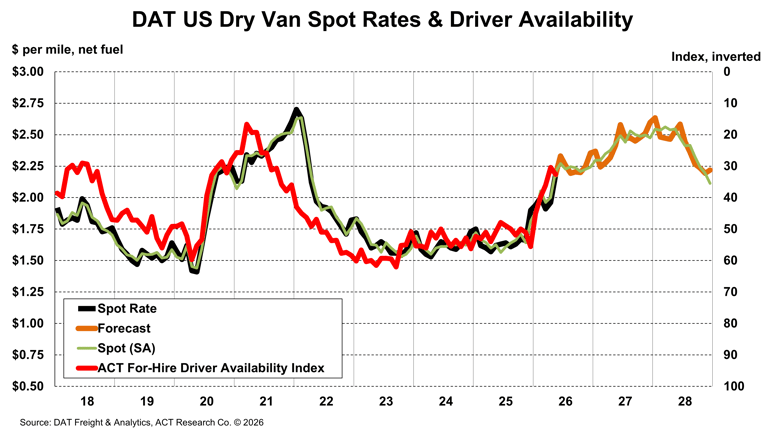
The ACT Driver Availability Index remained in shortage territory in May at 32.6. While up from 30.4 in April, this survey-based diffusion index is neutral around 50 and acutely tight below 40.
ACT Research forecasts through 2028 are detailed in the Freight Forecast report. This service provides in-depth analysis and forecasts for a broad range of U.S. freight measures, including the Cass Freight Index, Cass Truckload Linehaul Index, and DAT spot and contract rates by trailer type, with and without fuel. We provide monthly, quarterly, and annual predictions over a two- to three-year time horizon, including capacity, volumes, and rates. The ACT Research Freight Forecast is released monthly in conjunction with the Cass Transportation Index report.
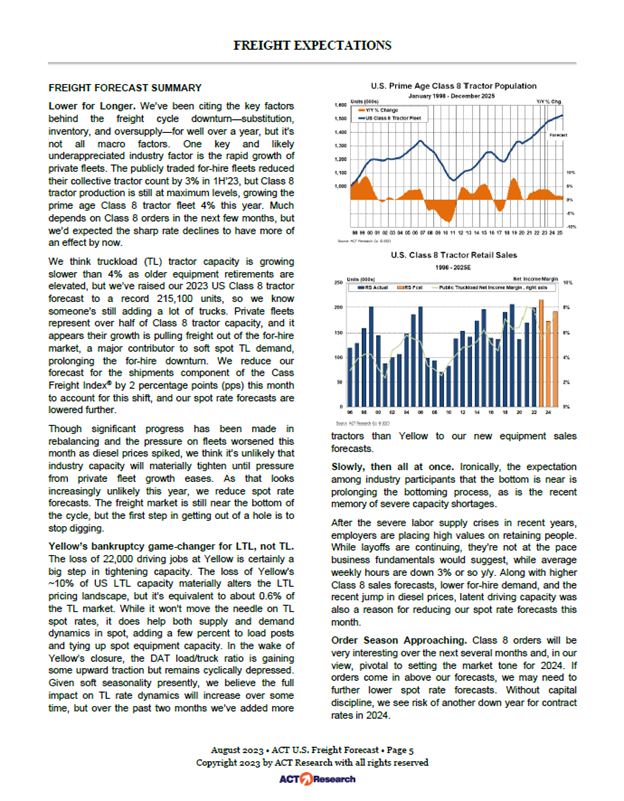
The ACT Research Freight Forecast now predicts 80 distinct data series covering TL, LTL, and intermodal volumes and rates, and we’re adding more. Rather than argue over precision, which in this industry can change quickly on wars or weather events, please see this one-page monthly summary, from 2.5 years ago. While these dynamics have reversed, we think it will help you understand why our supply-side perspective is helpful for planning, strategy, and forecasting.
(As a reminder, ACT Research’s Tim Denoyer writes this report.)
Release date: We strive to release our indexes on the 13th of each month. When this falls on a Friday or weekend, our goal is to publish on the next business day.