

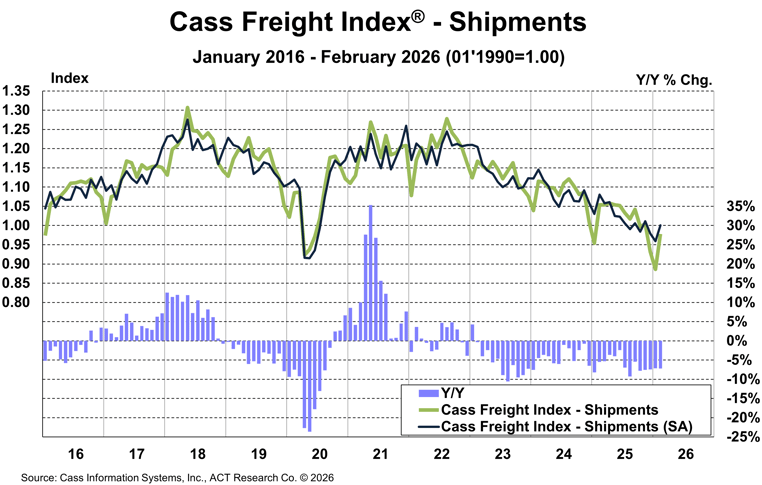
The shipments component of the Cass Freight Index fell 7.1% y/y but rose 10.4% m/m in February.
In seasonally adjusted (SA) terms, shipments rose 4.3% m/m, recovering much of the weather disruptions of the past two months.
The normal seasonal trend would put the shipments component of the Cass Freight Index down 5% y/y in March.
See the Methodology for the Cass Freight Index
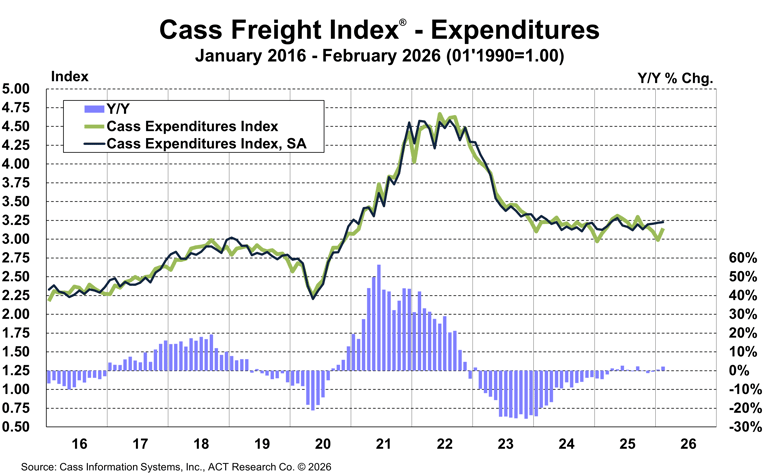
The expenditures component of the Cass Freight Index, which measures the total amount spent on freight, rose 5.1% m/m in February. Expenditures were up 2.1% from the year-ago level in February, after a 0.6% y/y gain in January.
While shipment declines continue, the year over year increase in expenditures was driven by higher rates.
In SA terms, the index rose 0.3% m/m in February, after a 0.4% m/m increase in January.
The expenditures component of the Cass Freight Index, after a record 38% surge in 2021 and another 23% increase in 2022, fell 19% in 2023 and 11% in 2024. In 2025, the index declined by 0.5%.
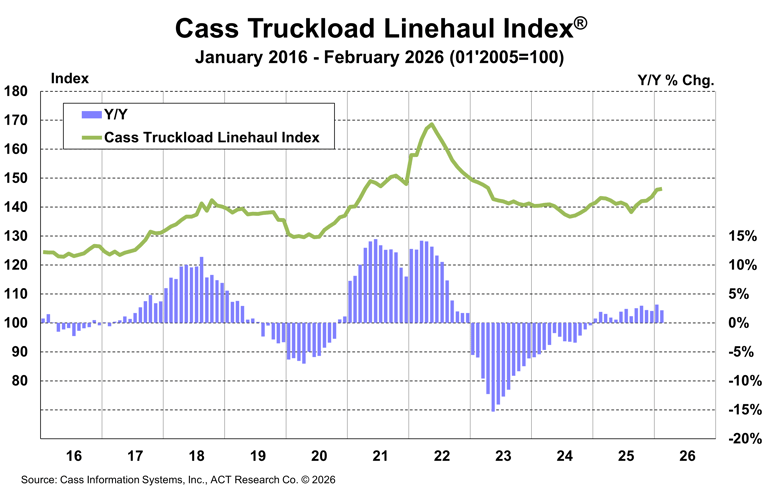
The Cass Truckload Linehaul Index rose 0.2% m/m in February, after a 1.7% increase in January.
Rates slowed to 2.2% y/y in February, from 3.2% in January, but accelerated to a 4.1% increase over two years ago, a new cycle high on the two-year stacked change.
Warmer weather could lead to some slowdown, but spot capacity remains tight in early March, positioning trucking rates to accelerate.
With volumes still soft around the industry, supply constraints are supporting higher rates. These constraints are not just weather, but equipment and increasingly drivers.
This index reflects the whole for-hire market, both spot and contract rates.
The Cass Truckload Linehaul Index fell 10% in 2023, another 3.4% in 2024, and turned up to a 1.8% increase in 2025.
See the Methodology for the Cass Truckload Linehaul Index
The recent strength in spot rates is going up against a surge in diesel prices. In the spot market, there isn’t always a fuel surcharge. Though it’s still helpful to analyze rate net of fuel, higher fuel costs won’t necessarily pass through. In the larger contract market, the shipper is generally responsible for fuel. This added 7%–8% to the cost of contract TL and LTL freight bills as of early March, assuming a $1 per gallon increase in the cost of diesel.
After the Supreme Court ruling lowering tariffs, and as driver availability had started to tighten, momentum in the spot market was building. An extra $1 per gallon will cause many of those good fleet drivers who are considering striking out on their own in the spot market to stay put. After 3.5 years of capacity contraction in the for-hire market, rates have begun a supply-driven recovery, even amid soft freight demand.
ACT Research’s forecasts through 2028 are detailed in the Freight Forecast. This service provides in-depth analysis and forecasts for a broad range of U.S. freight measures, including the Cass Freight Index, Cass Truckload Linehaul Index, DAT spot and contract rates by trailer type, LTL, and intermodal price indexes. We provide monthly, quarterly, and annual predictions for over forty data series over a two- to three-year time horizon, including capacity, volumes, and rates. The ACT Research Freight Forecast is released monthly in conjunction with the Cass Transportation Index report.
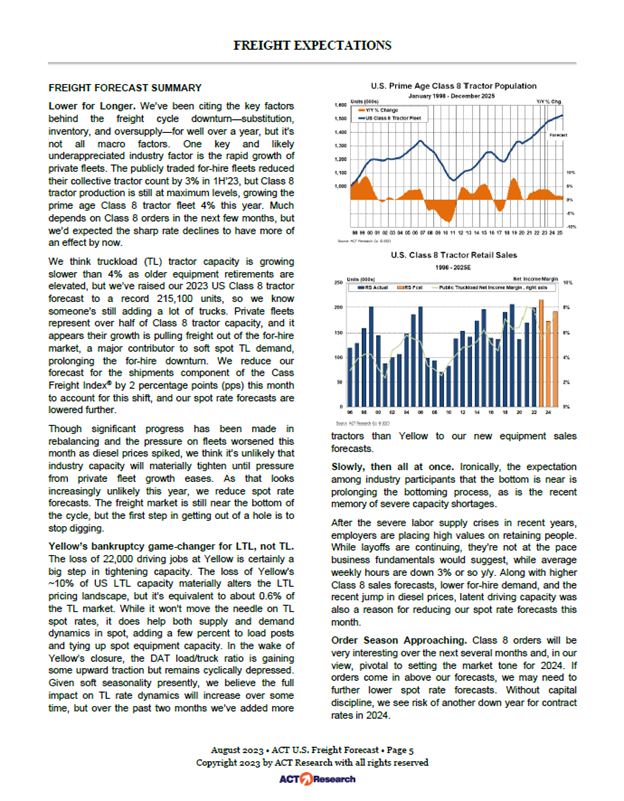
How have the freight forecasts performed?
The ACT Research Freight Forecast now predicts 74 distinct data series covering TL, LTL, and intermodal volumes and rates, and we’re adding more. Rather than another chart comparing forecasts to actuals, this one-page monthly summary, from 2.5 years ago, may be worth reading if you want to understand why our supply-side perspective is helpful for planning, strategy, and forecasting. But be warned, most of these trends have played out and are reversing.
(As a reminder, ACT Research’s Tim Denoyer writes this report.)
Release date: We strive to release our indexes on the 13th of each month. When this falls on a Friday or weekend, our goal is to publish on the next business day.