


Topics: Carrier Solutions, Transportation, Economic Shifts, Carrier Newsletter, FreightMarketTrends
Demand Grows, M&A Heats Up, and Phishers Target Carriers
Despite a decline in shipments and expenditures in January, U.S. freight demand is growing, according to ACT Research.
“The freight economy continues to grow, and the for-hire recovery will begin when private fleet capacity, which has been in contraction since 2025, becomes tight. This did just happen, in fact, but the real test will be during softer seasonal periods like March and April,” said ACT Research’s Tim Denoyer, author of the Cass Transportation Index Report.
“Fleets are getting excited that the long-awaited recovery is here. Even 2% contract rate increases are a relief after four years of nothing or worse. While near-term reversion from the weather may slow the trend, we expect tighter capacity to lead to moderate truckload rate increases in 2026.”
The shipments component of the Cass Freight Index fell 7.1% year over year and 4.9% month over month. The expenditures component also declined, decreasing 3.6% month over month; the year-over-year result was basically flat, inching up just 0.6% from January 2025. The Cass Truckload Index rose 1.7% month over month in January after a 1% increase in December.
“Rates rose 3.2% y/y as weather challenged volumes,” the January report said. “Warmer weather should lead to some trend reversion, but for February at least, spot rates are likely to accelerate.”
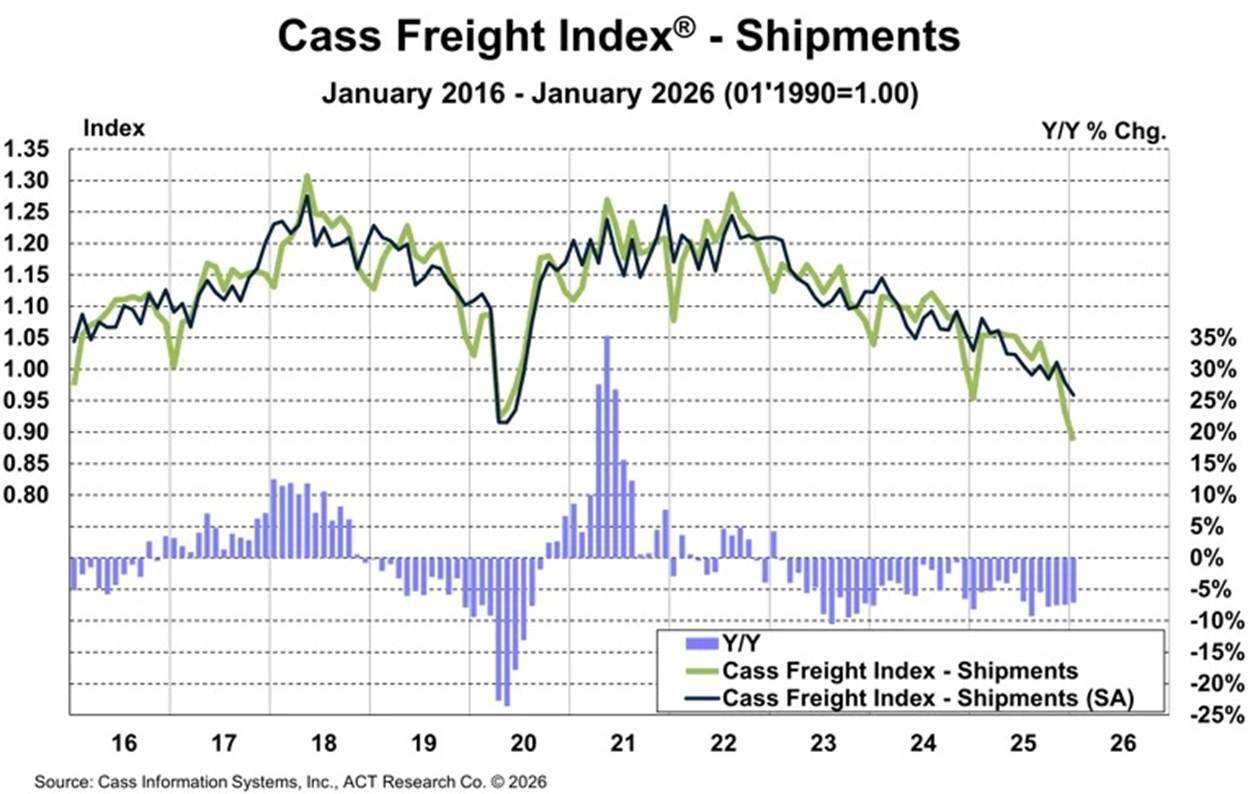
Cass Information Systems provides the most up-to-date data and insights into North American shipping volumes and the cost of freight in our monthly Transportation Indexes Report. Get insights for January 2026 here. Staying abreast of developments in the freight market is essential, and at Cass, we continue to keep industry stakeholders apprised of issues important to them through our monthly news roundup.
Mergers and Acquisitions
Analysts Expect ‘Continued Consolidation’ of Carriers in 2026
Trucking Dive’s conclusion from PwC’s transportation and logistics deals outlook was that the “economy, technology, and uncertainty” all could be motives for trucking industry M&A activity in 2026.
“Prolonged weak freight conditions and excess market capacity may sideline purchasing aspirations for some, as carriers look to reduce their capacity rather than augment it through acquisitions. However, opportunists may view the current business climate with low interest rates and distressed carriers as perfect for dealmaking,” Trucking Dive said.
PwC said M&A targets this year could include “platforms that enable network optimization, automation, and resilience.”
Trucking Dive quoted Darach Chapman, PwC’s transportation and logistics deal leader, as saying that analysts “expect continued consolidation as smaller or subscale operators look for exits and better-capitalized buyers pursue targeted acquisitions. That said, strategic buyers will remain selective, focusing on cost synergies, network fit, and contractual revenue rather than volume growth alone.”
2025 Was Year of ‘Adjustment Rather Than Recovery’
Tenney Group said M&A activity slowed in 2025, a year of “adjustment rather than recovery” amid the lingering freight recession and tariff policy uncertainty.
According to Tenney Group’s 2026 M&A report, global transactions in the transportation sector have declined from 1,797 deals in 2021 to 1,150 in 2025.
The Commercial Carrier Journal (CCJ) said M&A targets last year were focused on “companies with recurring demand, pricing power, and defensible service models,” but the Tenney Group report “noted that tariff policy increased the scope, duration, and cost of due diligence, which both postponed and, in some cases, caused buyers to walk away.”
Werner Acquires FirstFleet for $283 Million
There has been some M&A activity already in 2026. Werner Enterprises kicked off the year by acquiring FirstFleet for $283 million in an all-cash deal.
The deal, which closed in late January, added about 2,400 tractors to Werner’s dedicated trucking division.
“By uniting FirstFleet’s expertise in complementary new verticals with our resources and nearly 5,000 Dedicated trucks, we will improve our competitive position and accelerate profitable growth,” Werner Chairman and CEO Derek Leathers said.
The Werner announcement said the combination will make it the fifth-largest dedicated carrier in the United States and increase its presence in more resilient categories like grocery and baked goods.
Murfreesboro, Tennessee-based FleetFirst, privately held since its founding in 1986, will operate as a business unit within Werner’s truckload transportation services segment.
FirstFleet co-owner Paul Wilson said the deal was an “opportunity to leverage best-in-class technology and deliver significant value to stakeholders.”
Trucking Industry
‘Aggressive Phishing Campaign’ Targeting Carriers
The Federal Motor Carrier Safety Administration (FMCSA) has issued an alert that “a new, aggressive phishing campaign” is targeting motor carriers.
The CCJ reported that carriers are receiving emails claiming to be from the U.S. Department of Transportation (DOT) or FMCSA officials. But the FMCSA said those emails “are fake and designed to steal sensitive information or demand illegal payments.”
Official correspondence from the FMCSA almost always uses an email address ending in .gov, and the agency said it would never request payment or sensitive information through unsolicited messages.
The FMCSA advised carriers not to click on links in unexpected emails and verify communications through the FMCSA Call Center or by calling (800) 832-5660.
Tight Capacity Could Make for ‘Unprecedented Produce Season’ in California
Truck shortages have been reported in all five of California’s produce regions, and “tighter capacity could make this an unprecedented produce season,” according to DAT Freight & Analytics’ Dean Croke.
Croke cited an increase of immigration enforcement as one reason why carriers are avoiding California. He said carriers also are choosing better-paying freight with fewer delays in Texas and Florida.
Regulatory enforcement, particularly the crackdown on non-domiciled CDL holders, also is affecting trucking capacity across the country.
“While we did see some improvement in overall demand and a tightening spot market in December, it was a reduction in available capacity that seemed to be the primary driver of the tightening market,” Knight-Swift CEO Adam Miller said on a recent earnings call.
For-Hire Trucking Market and Freight Volumes Grew in December
The for-hire trucking market improved in December as the overall supply-demand balance hit its strongest level in four years, Fleet Equipment Magazine reported.
Fleet Equipment cited the For-Hire Trucking Index from ACT Research, which said winter weather and seasonal demand combined tightened capacity early in December, and holiday spending supported freight volumes.
ACT’s Volume Index increased seven points from November to December and reached its highest levels since late 2021.
“While gains may relax as the weather improves, there are positives entering 2026. The economy continues to exceed expectations, and there are temporary aspects to both the increases in supply and demand,” ACT Research’s Carter Vieth said. “Capacity continues to exit the market, though a small prebuy ahead of EPA’27 will slow velocity of tightening, and the potential tailwind of IEEPA tariff reversals seems likelier than not.”
Carriers
Werner Paying $18 Million to Settle Wage Lawsuit
Werner has agreed to pay $18 million to settle a wage lawsuit that dates back to 2014.
A group of truck drivers alleged that Werner broke California law by failing to pay wages for compensable non-driving time and charged drivers a $4 transaction fee to receive wage advances.
About 100,000 current and former Werner truck drivers are eligible for a portion of the settlement, according to Land Line. Seven plaintiffs will receive $15,000 each. Twenty-one drivers who sat for depositions will receive $250 each.
Crashes Cost Landstar $16.7 Million in Q4
Legal woes also have impacted Landstar System, which reported a $16.7 million hit in the fourth quarter of 2025 “after three crashes sent costs upward,” Trucking Dive said.
Landstar’s Q4 operating income dropped 49% year over year to $29.6 million, while insurance and claims costs jumped to $56 million, up from $30.1 million in the same period in 2024.
In the case of a 2021 crash in Texas, Landstar Ranger was held responsible for 100% of the $22.8 million in damages awarded. Landstar said it “plans to vigorously appeal this matter.”
ArcBest Gets Boost From New LTL Business
Thanks to an influx of new LTL business, ArcBest’s ABF Freight increased its daily shipments in the fourth quarter by 2.4% year over year.
ArcBest Chief Commercial Officer Eddie Sorg said the carrier is “very committed to get the most out of every opportunity and every piece of business that we have to produce the profit that we want that supports our long-term targets.”
ArcBest President and CEO Seth Runser said the company is balancing growth with cost control and efficiency as its customer pipeline expands, according to Trucking Dive.
“When I think about our company, we’re built for any environment because we stay close to our customers,” Runser said during an earnings call. “The way we’ve built this company is to be responsive and say, ‘Yes,’ regardless of the market conditions. So our customers continue to come to us with challenges, and we’re really focused on what’s in our control.”
Filter Promoted to Lead Schneider National
Jim Filter, Schneider National EVP and group president of transportation and logistics, will be promoted to president and CEO on July 1.
Filter will assume the role of Mark Rourke, CEO since 2019, who will transition to executive board chairman. Filter has been with Schneider for nearly 30 years and has held a variety of leadership roles in logistics and supply chain management.
“Schneider is well positioned for significant growth, and I’m eager to lead our talented team in advancing our technology solutions, expanding our multimodal network, and driving operational growth and excellence to create enduring value for all stakeholders,” Filter said in a statement.
Government
Spending Bill Includes $200 Million for Truck Parking
The $1.2 trillion federal spending bill signed by President Donald Trump in early February includes $200 million to expand commercial truck parking across the country.
“This substantial new funding that ATA championed will help us turn a corner on this issue,” American Trucking Associations President and CEO Chris Spear said in a statement.
Truck drivers reportedly spend an average of 56 minutes of drive time each day looking for a safe place to park.
“When truck drivers finish their shift or take their federally mandated rest break, the last thing they should have to worry about is finding a safe place to park,” Spear said.
English Language Proficiency Rule Signed Into Law
President Trump’s English language proficiency (ELP) executive order was signed into law as part of the bill to end the partial government shutdown.
The CCJ reported that the DOT “is now required to update its regulations to reflect that an out-of-service order is triggered by noncompliance with 49 Code of Federal Regulations 391.11(b)(2), which requires commercial motor vehicle drivers to ‘read and speak the English language sufficiently to converse with the general public, to understand highway traffic signs and signals in the English language, to respond to official inquiries, and to make entries on reports and records.’”
How Cass Powers Progress in Transportation
Cass supports the needs of North America’s transportation industry through several key solutions.
Cass Commercial Bank—the backbone of the Cass payments infrastructure—provides customized equipment and vehicle finance solutions based on deep experience across all industries and economic cycles. Contact Scott Williams at (513) 545-4605 or swilliams@cassbank.com to learn more.
For the thousands of carriers in our payment network, Cass provides flexible, customized early payment solutions that align with business goals.