


Topics: News, Equipment Financing, Carrier Newsletter, FreightMarketTrends, CassFreightIndex
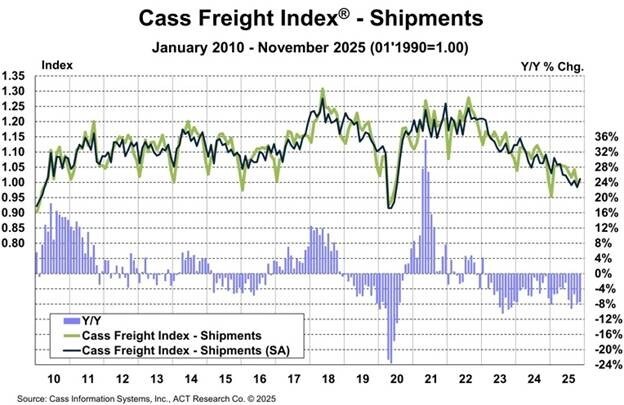
The shipments component of the Cass Freight Index climbed 0.7% month over month (m/m) in November, or 2.7% m/m in seasonally adjusted (SA) terms, reversing a 2.1% SA decline in October.
The expenditures component of the Cass Freight Index slipped just 0.2% m/m, and for 2025 overall, the index is expected to decline by less than 1%, “and it could end up flat with a strong December,” according to ACT Research’s Tim Denoyer, author of the Cass Transportation Index Report.
“The flattish results of the past few months were a combination of lower shipments and higher rates,” Denoyer wrote. “We infer rates rose 6.8% y/y, largely due to changing modal mix with more TL and less LTL, similar to recent months.”
The Cass Truckload Linehaul Index, which measures changes in linehaul rates, inched up 0.1% m/m in November, following a 1.1% increase in October.
“As holiday spending surpasses low expectations and weather adds to capacity constraints amid the holidays, the market balance is briefly tipping toward fleets in December,” Denoyer said.
Cass Information Systems provides the most up-to-date data and insights data and insights into shipping volumes and the cost of freight in our monthly Transportation Index Report. Get the latest insights here.
As we close out the year, we look back on top trending industry news in 2025 as well as what’s expected to make headlines in 2026. While truckload volumes are expected to remain muted through the end of the year, improvement could occur in 2026, according to RXO’s late-November Curve report.
“If the Fed continues to cut interest rates, it’s possible we’d see a boost in [the Manufacturing Purchasing Manager’s Index], as businesses would have cheaper cost of capital to invest in and expand their operations,” RXO said.
Carriers
Tonnage Declines, Economic Headwinds Dominated 2025
A Commercial Carrier Journal (CCJ) headline in late November said it all: “Freight recovery faceplant: Why did 2025 suck for transportation?”
The article summed up the state of the freight industry as 2025 comes to an end. “Despite widespread forecasts predicting a recovery, the trucking industry faced a stagnant 2025, with October tonnage hitting its lowest level in nearly two years due to a combination of federal policy uncertainty and economic headwinds,” it said. “Analysts attribute this underperformance to companies pausing capital investments amid tariff volatility, a surprise 8-10% decline in housing starts, and weakened manufacturing activity that failed to rebound as expected.
“Compounded by persistent inflation and high interest rates that have stressed consumer spending power and slowed housing turnover, the sector is projected to finish the year potentially below 2024 levels, with the first half of 2026 expected to remain tepid as the market lacks a clear catalyst for substantial growth.”
Class 8 Truck Orders Continue to Fall
Class 8 truck orders again fell in November, this time by 17% month over month and 44% year over year, according to FTR Transportation Intelligence.
The 20,200 units ordered was significantly below the historical 10-year November average of 28,910 and the 11th consecutive month of annual declines.
Dan Moyer, FTR’s senior analyst for commercial vehicles, said fleets are still prioritizing cost control and delaying purchasing decisions until they see any meaningful freight rebound.
“For truck manufacturers and suppliers, forward visibility remains limited, and order activity is likely to remain uneven until freight volumes and rates show a sustained recovery,” Moyer said.
More Fleet Failures Expected in 2026
Avery Vise, FTR’s vice president of trucking, told the CCJ that he expects stagnant rates and continued carrier failures in 2026. While freight volumes are forecast to recover beginning in the spring, rate growth will “remain anemic.”
Avery said a rate increase of less than 2% will likely be unsustainable for many fleets already facing rising costs for equipment and insurance. “If we have that tepid of a rate growth … there is no way we’re going to keep the capacity levels in the range that we have them now. We will lose a lot of carriers,” he told the CCJ.
Just this month, 10 Roads Express, an Iowa-based U.S. Postal Service contractor, announced it is closing by the end of January. 10 Roads reportedly has 2,500 trucks and 2,600 drivers.
“Our industry has been navigating unprecedented challenges, and despite the dedication of our employees and leadership, the realities of the industry have become impossible to overcome,” a 10 Roads spokesperson told the CCJ.
Also earlier in December, the Hogan family-owned trucking company, with about 3,000 employees, 10,000 pieces of equipment, and 50 locations, was sold to Enterprise Mobility.
“The change in ownership for Hogan, which began operations in 1918, comes as trucking businesses seek to fend off a prolonged freight recession,” Trucking Dive reported.
Texas International Enterprises filed for Chapter 11 bankruptcy on December 6. The general freight carrier reportedly had 280 power units and 600 drivers at the beginning of the year.
Jerry Maldonado, chairman of the Laredo Motor Carriers Association, told Trucking Dive that excess capacity and lower freight volumes are keeping rates depressed, making the freight market increasingly difficult for some trucking companies to remain operational.
“We hope all of our trucking partners can remain successful and continue operating; unfortunately, that has not been the case for several companies, not only in Laredo but across the country,” Maldonado said.
Cargo Theft
Lawmakers Aim to Amp Up Cargo Theft Fight
Cargo theft has become a huge problem across the country, and now some lawmakers want to take a different approach to fight crime.
U.S. Sens. Marsha Blackburn, R-Tenn., and Amy Klobuchar, D-Minn., earlier in December introduced the Cargo Security Innovation Act, which would, in part, require the Transportation Security Administration (TSA) to establish a pilot project to evaluate the “effectiveness of advanced law enforcement and cargo security technologies at combating cargo theft in transit and at and around intermodal transportation hubs and rail yards with elevated levels of cargo theft.”
Klobuchar said, “Cargo theft significantly impacts the supply chain, harming American businesses and consumers, especially food shippers. When criminals break into shipments, businesses are forced to return containers and dispose of compromised products. Our bipartisan legislation would equip law enforcement with the resources to combat these crimes — creating a pilot program that invests in technology to curb cargo theft.”
Federal Regulations
CDL Training Providers Removed From FMCSA Registry
The U.S. Department of Transportation (DOT) on December 1 announced the removal of nearly 3,000 commercial driver’s license (CDL) training providers from the Federal Motor Carrier Safety Administration (FMCSA) Training Provider Registry (TPR) “for failing to equip trainees with the Trump Administration’s standards of readiness.”
Another 4,500 training providers reportedly were placed on notice due to potential noncompliance.
The DOT said CDL training providers are being removed from the TPR due to:
- Falsifying or manipulating training data.
- Neglecting to meet required curriculum standards, facility conditions, or instructor qualifications.
- Failing to maintain accurate, complete documentation or refusing to provide records during federal audits or investigations.
“This administration is cracking down on every link in the illegal trucking chain,” DOT Secretary Sean Duffy said in a news release. “Under Joe Biden and Pete Buttigieg, bad actors were able to game the system and let unqualified drivers flood our roadways. Their negligence endangered every family on America’s roadways, and it ends today. Under President Trump, we are reigning in illegal and reckless practices that let poorly trained drivers get behind the wheel of semi-trucks and school buses.”
NPR reported that thousands of the country’s 16,000 authorized CDL training providers could lose accreditation as part of the DOT crackdown, which it said is part of a push for tougher regulations following a series of deadly crashes involving foreign-born truck drivers.
NPR said Duffy has argued that “the restrictions are urgently needed because there are too many foreign-born truckers who don’t know the rules of the road and don’t speak English proficiently.”
DOT Continues Crackdown on Non-Domiciled Truckers
As part of the ongoing crackdown on non-domiciled truck drivers, the Trump administration has recently threatened to pull federal funding from the states of Minnesota and New York, alleging they have illegally issued CDLs to non-domiciled truckers.
DOT investigations earlier targeted the states of California and Pennsylvania.
DOT Secretary Duffy asserted earlier this month that one-third of the non-domiciled CDLs issued in Minnesota were done so illegally. Truck News reported that the state was given 30 days to revoke those licenses or risk losing up to $30.4 million in federal funding.
The DOT alleged that an audit discovered drivers whose CDLs were valid after their lawful presence in the United States expired; drivers who were prohibited from holding a non-domiciled CDL; and drivers who had not been verified by Minnesota to be lawfully present in the United States.
In New York, an FMCSA audit reportedly revealed that 53% of more than 32,000 non-domiciled CDLs — some 17,000 licenses — issued by the state did not comply with federal law. That allegedly included awarding CDLs to foreign applicants with expired visas or work authorizations.
FMCSA Administrator Derek Barrs charged that the state of New York “blindly issues non-domiciled CDLs with an eight-year expiration — long past when drivers should lawfully be in this country.”
As with Minnesota, New York was given 30 days to comply with the order to rescind CDLs not in compliance with federal law or risk losing millions of dollars in funding.
Duffy said that “millions of people came into the country during [the Biden-Buttigieg] tenure when these rules were in place but they turned a blind eye, and we saw the safety on our roadways diminish. But Derek and I are going to enforce the law and hold states accountable and make sure Americans are safer. President Trump gave us that directive, and it’s the right directive.”
FMCSA Overhauling ELD Vetting Process
The FMCSA announced a “complete overhaul of the vetting process for Electronic Logging Devices” because of what was called blatant tampering and fraud.
It said the overhaul is designed to ensure “noncompliant devices are blocked before they ever reach FMCSA’s Registered ELD list.”
The FMCSA reportedly found loopholes in the approval process that allowed noncompliant devices to become registered. The agency also learned of vendors offering to help carriers tamper with ELD devices to cheat hours of service (HOS) regulations.
“American families deserve to feel safe sharing a road with semi-trucks, and we want truck drivers to have the best tools to maximize those safety precautions,” FMCSA Administrator Barrs said. “By strengthening our review process for ELDs, we are ensuring the industry can rely on trusted equipment and that hardworking drivers are prioritizing their health and well-being, so they are best prepared to keep driving America’s economy forward.”
Technology
Geotab CEO: Fleets That Fail to Integrate AI Will Be Left Behind
Geotab CEO Neil Cawse believes “2026 will mark the end of AI as a tool and the beginning of AI as an operational partner running core fleet workflows,” according to a CCJ article.
Cawse told the CCJ that fleets that fail to integrate AI in their operations will be left behind. Digitization will be key to their efforts.
“I’m absolutely convinced that in three years, five years down the road, we’re going to have an absolutely steaming ahead economy because every single company in the world is going to be able to benefit from AI,” Cawse said.
Legal
Large Payouts in Trucking Lawsuits Keep Rising
A Dallas jury has ordered New Prime Inc. to pay $44.1 million in the latest nuclear verdict against a carrier.
Six people died during a series of pileups on Interstate 35 on February 11, 2021. One man died of injuries sustained when his vehicle was rear-ended by a New Prime semi-truck. The jury found that the driver had not received adequate winter weather driving training and was driving too fast given the hazardous conditions.
Litigation awards increased significantly between 2011 and 2023, with the median payout climbing at an average rate of $59,122 per year, according to a new American Transportation Research Institute (ATRI) study.
“Exorbitant litigation has become increasingly challenging for the trucking industry,” the study said.
A developing threat is third-party litigation funding (TPLF), in which outside investors fund lawsuits in exchange for part of the settlement. The ATRI warned this practice prevents reasonable settlements as investors push for maximum payouts to ensure a return on their investment.
M&A
Performance Food Group and US Foods Deal Off
Performance Food Group and US Foods have called off their planned merger. The combination of the two companies would have created a private fleet of more than 12,000 tractors and 15,000 trailers.
“Following a comprehensive evaluation of regulatory considerations and synergies related to a potential business combination with US Foods, with the assistance of our independent financial and legal advisors, we have decided to terminate discussions,” PFG Chairman and CEO George Holm said. “Our Board of Directors is unanimous in its belief that the clearest and best path to long-term stockholder value is executing our standalone strategic plan, leveraging our diverse business segments to drive consistent revenue and profit growth.”
BNSF Doesn’t Support UP, Norfolk Southern Merger
BNSF Railway wants the Surface Transportation Board (STB) to review a 30-year-old deal before a merger between Union Pacific (UP) and Norfolk Southern is approved.
UP and Norfolk Southern announced an agreement in July to create the country’s first transcontinental railroad in an $85 billion deal, which has to be approved by the STB. BNSF has petitioned the STB to look at “UP’s longstanding pattern of obstructive conduct, which has eroded competition and harmed customers.”
BNSF wants to ensure the STB enforces conditions imposed during UP’s merger with Southern Pacific (SP) in 1996. Since that merger, according to BNSF, “UP has repeatedly resisted efforts to preserve competitive rail service, despite conditions established by the STB to protect shippers. BNSF has worked diligently to uphold these rights through negotiations, oversight, and formal petitions, yet UP’s obstruction has left many customers with fewer service options than before the merger.”
Cass Equipment Financing
Cass Commercial Bank Equipment Financing finances trucks, trailers, and equipment. Contact Scott Williams, Vice President Commercial Equipment Finance, at (513) 545-4605 or swilliams@cassbank.com to learn more.
Why Q4 Is a Strategic Time for Equipment Financing
As the year winds down, the fourth quarter presents unique advantages for leasing or purchasing equipment. Here’s how businesses can turn timing into value:
💰 Maximize Tax Efficiency
- Accelerated Depreciation: Buyers can leverage 100% bonus depreciation while only recording a fraction of the year’s taxable income, amplifying the economic impact.
- End-of-Year Tax Planning: Equipment ownership benefits remain constant, but their value increases when applied against year-end financials.
📊 Optimize Budget Utilization
- Use It Before You Lose It: Many purchasing budgets expire at year-end. Q4 is the last window to deploy remaining funds strategically.
🤝 Leverage Seller Incentives
- Year-End Sales Goals: Sellers are motivated to close deals before December 31, often offering better terms or pricing to hit annual targets.
📅 Strategic Timing for Lease Terms
- Push End-of-Term into Next Tax Year: Structuring leases to end in a future tax year can improve cash flow and optimize financial reporting.
📈 Protect Against Price Increases
- Lock in Current Rates: Financing now helps hedge against potential equipment price hikes in the new year.
🚚 Boost Holiday Capacity
- Meet Seasonal Demand: For retail and logistics, Q4 equipment purchases can increase throughput during peak season.
🔄 Improve Financial Presentation
- Recapitalize or Refinance: Q4 is a smart time to restructure debt or refinance equipment, enhancing cash flow and balance sheet optics before year-end reporting.