


Topics: Freight Audit & Payment, Transportation, Carrier Newsletter
Class 8 Truck Orders Drop 36% Year Over Year
Uncertainty over implementation of the EPA’s 2027 NOx regulations was blamed for the 24% month-over-month drop in North American Class 8 orders. The 15,600 units ordered in October marked a 36% year-over-year decrease.
“Weak October results suggest that some purchases may be deferred rather than canceled, potentially allowing orders to strengthen as emissions requirements, production schedules, and equipment pricing become clearer,” Dan Moyer, FTR’s Senior Analyst of Commercial Vehicles, said.
During an early November episode of The 10-44 podcast, host Jason Cannon said, “Going into the year, a lot of folks were anticipating a massive pre-buy ahead of upcoming emissions regulations. But that didn’t really materialize the way people expected.”
He added that “fleets found themselves in a wait-and-see situation, and with the freight market remaining flat, brand-new trucks weren’t critically required to move the limited freight volume available.”
Cannon said used truck prices spiked in late summer, but are expected to stabilize heading into 2027 with a growing supply.
Limited Visibility Top Frustration With Rail
Eighty-four percent of 500 U.S. logistics, transportation, and supply chain decision-makers surveyed would increase their use of rail if visibility into goods in transit improved.
Limited visibility was listed as the top frustration when using rail, and only 23% of the industry stakeholders surveyed by global security technology company Giesecke+Devrient said they have continuous real-time location tracking for freight shipped via rail.
“Rising truckload rates due to high fuel prices and tightening carrier capacity could trigger shipper customers to shift their freight movements to rail, but a key benefit that rail often lacks gives trucking a leg up in the competition: visibility,” the Commercial Carrier Journal (CCJ) reported.
Some freight has shifted to rail. The Association of American Railroads said U.S. rail traffic was up 2.7% year over year through the beginning of October, and intermodal traffic was up 4.2%.
“Of course, as costs in trucking — i.e., diesel — surge, many shippers are willing to be flexible on transit times and choose intermodal instead. That decision will be specific to the type of freight and how lean or flush inventory levels are at warehouses and distribution centers,” said Avery Vise, Vice President of Trucking at FTR Transportation Intelligence. “It’s a fair assumption, though, that the availability of real-time tracking would make intermodal more competitive in those situations.”
There are challenges to providing real-time visibility for freight moving by rail.
“Every tractor on the road has a continuous power source. That means we can run heavy-duty telematics, smart dashcams and mobile devices that ping location, vehicle health, and driver status near-instantly — sometimes every few seconds,” Erin Cave, Global Vice President of Product Management at Verizon Connect, told the CCJ. “Rail has a much tougher physics and logistics problem, including power and battery constraints. A boxcar or container sitting on a track doesn’t have an engine generating electricity so any tracking hardware attached to a railcar relies on solar or internal batteries, so to make those devices last, they ping far less frequently.”
Fleets Automating Back-Office Tasks With Agentic AI
Carriers on hand for the WEX OTR Summit in late October reported they are actively deploying automated tools to handle such duties as driver log auditing, load entry, and cash application.
Patrick Cozzens, President and CEO of Modern Transportation Services, said an automated agent now handles about 85% to 90% of the company’s invoice matching.
“It’s one of those tasks that I think every human hates,” Cozzens said, according to the CCJ. “It’s laborious, it takes time, and you delay your billing cycle until you can get it done.”
In a separate article, the CCJ reported that expedited trucking company Load One is using AI agents to slash quote response times from minutes to mere seconds.
When a Load One customer sends a rate request, an AI-powered agent instantly reads the message using a large language model and calculates a competitive rate in about two seconds.
“It learns. So it can detect and it can understand the difference between someone saying, ‘I need to move a Sprinter van from here to there,’ versus someone asking for an update on a Sprinter van that’s already moving,” Load One President and CEO Chad Tabor said.
Once a quote is built and a truck is available, a human calls the driver and goes over the load details, timing, and pay.
“Leveraging AI to make your people more powerful is absolutely the future of the trucking industry,” Tabor said. “I don’t think there’s any secret to that. So I think the smart executives, they’re figuring out how to do it.”
Freight Cycle Finds a Higher Gear
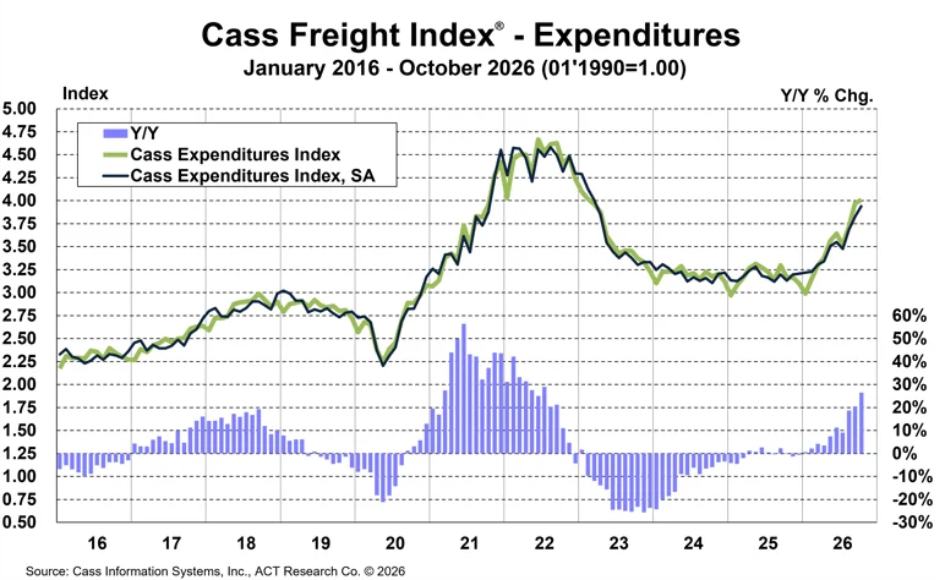
“We continue to see the freight demand cycle gaining steam, and with record container imports and intermodal volumes, and growing LTL tonnage, the improvement has broadened out some in recent months,” ACT Research said with the release of the October Cass Freight Index.
The shipments component of the index illustrated that freight demand is indeed gaining steam. Volumes climbed 5.9% year over year in October, accelerating from a 1.9% gain in September. The normal seasonal pattern would put the shipments component of the index up 3% year over year in November.
The expenditures component of the Cass Freight Index jumped 27% year over year in October, up from a 20% gain in September.
After declines in 2023, 2024, and 2025, the expenditures component of the index is on track for a 13% gain this year (the 2026 average compared to the 2025 average).
The Cass Truckload Linehaul Index rose 0.9% month over month and 9.9% year over year to 156.2. After falling 10% in 2023 and another 3.4% in 2024 before turning upward to a 1.8% increase in 2025, the Cass Truckload Linehaul Index is on track for a 7% increase in 2026.
“We think freight volumes have entered the growth phase of the cycle,” ACT Research concluded in its Freight Forecast.
Subscribe to the Cass Transportation Indexes here.
Cargo Theft Incidents Down But Loss Value Up
While the number of cargo thefts in the third quarter decreased 33% from the same period in 2025, the losses were valued at 12% more.
Verisk CargoNet reported 547 supply chain crime incidents across the United States and Canada in Q3. The estimated total loss value was pegged at more than $230 million.
Food and beverage commodities were the most targeted, followed by metals. About one-third of the reported incidents took place in California.
“We’re seeing criminals combine digital deception with traditional theft tactics to identify, intercept, and redirect high-value shipments,” said Keith Lewis, Verisk CargoNet’s Vice President of Operations. “Data center materials are among the valuable commodities attracting attention. As the value of the cargo being targeted increases, strong identity verification, shipment visibility, and communication across the supply chain become even more important.”
LTL Carriers Report Third-Quarter Gains
The third quarter was generally a good one for LTL carriers, and Old Dominion Freight Line, for one, expects Q4 tonnage and revenue “above seasonality.”
“We feel like we’re seeing some good market share opportunities,” Old Dominion EVP and CFO Adam Satterfield said on a call with industry analysts.
Old Dominion reported a 26.9% year-over-year increase in Q3 net income, from $270.9 million to $343.7 million. Revenue was up 13.1% from $1.41 billion to $1.59 billion.
Saia reported record third-quarter revenue of $982.5 million, up 17% from $839.6 million in Q3 2025. Net income grew 5.9% to $91.4 million. Saia said heavier freight and strong pricing also pushed it to record tonnage, an 8.9% year-over-year increase.
ArcBest also saw a tonnage increase in Q3, with a year-over-year 9.6% hike in tonnage per day. ArcBest’s asset-based operating income grew from $70.2 million in Q3 2025 to $75.6 million in Q3 2026.
Like Old Dominion’s Satterfield, Saia CEO and President Seth Runser was cautiously optimistic.
“As we look forward to 2027, we’re not assuming a significant freight recovery, but we’re seeing some early signs that are encouraging,” Runser said.
PAMT, meanwhile, reported a Q3 operating loss of $5 million, although it was an improvement from a year ago, with operating revenue increasing by $12.3 million year over year.
President and CEO Lance Stewart said that “cumulative cost increases continue to outpace the pricing improvements achieved to date.”
Still, Stewart was encouraged by the Q3 results. “We remain optimistic that rates will continue to improve as the market adjusts to ongoing cost pressures and reduced industry capacity,” he said.
Cass provides flexible, customized early payment solutions that align with the business goals for carriers of all types and sizes. Customized equipment and vehicle finance solutions are also offered through Cass Commercial Bank.

